
Estimated reading time: 6 minutes
In the heart of every Moroccan home on a Friday afternoon, the air is thick with the fragrant steam of Couscous, or “Seksu.” This isn’t just a meal; it is a sacred family ritual, a cultural emblem, and a symbol of Moroccan hospitality that has remained unchanged for centuries.
Couscous, or “Seksu,” stands at the very heart of Moroccan culinary identity, a dish that transcends time, region, and social class. More than a food, it is a tradition, a family ritual, and a cultural emblem that unites Moroccans across generations. From bustling cities to remote villages, no Friday meal feels complete without the steam of couscous filling the air, a scent that carries centuries of history and shared memory.
A Symbol of Moroccan Identity
It is often said that you cannot mention Morocco without mentioning couscous. The dish is so deeply woven into Moroccan life that it is considered the national dish of Morocco, representing generosity, family, and continuity. Whether enjoyed in palaces or humble homes, couscous has maintained its royal place on Moroccan tables, adapting to modern life while preserving its authenticity.
In Moroccan culture, couscous is more than sustenance, it is a weekly ritual, most commonly served on Fridays, the day of communal prayer. Even as fast food and global cuisines rise in popularity, couscous remains unshaken in its place of honor. It embodies the Moroccan balance between tradition and modernity, a dish that evolves but never loses its soul.
Ancient Roots: The Amazigh Origins of Seksu
The origins of couscous stretch deep into North Africa’s history. Historical records and oral traditions trace its birth to the Amazigh (Berber) people, the original inhabitants of Morocco and much of the Maghreb. As the 14th-century historian Ibn Khaldun recorded, when the Berbers were asked about their identity, they replied proudly: “We are a people who shave our heads, wear the burnous, and eat couscous.” These three elements, simplicity, resilience, and shared heritage, continue to define Moroccan life today.
The term “couscous” itself derives from Amazigh roots, known variously as Ask’su, Seksu, Uftti, Arway, or Adnbo depending on regional dialects. In the Amazigh language, the word also means “food” or “meal,” illustrating its central role in daily sustenance. The utensil used to steam it, the keskas (known in French as couscoussier), also takes its name from the same linguistic root, showing how language and lifestyle intertwined around this sacred dish.
Culinary Heritage Through the Centuries
Historical culinary texts confirm that couscous has been part of Moroccan and Andalusian cuisine since at least the Middle Ages. One of the earliest known recipes appears in the 13th-century manuscript “Fadalat al-Khiwan fi Tayyibat al-Ta’am wal-Alwan” by Ibn Razin al-Tujibi, an Andalusian scholar who detailed the preparation of “al-Kuskusu.”
In his description, Ibn Razin outlined a meticulous process that mirrors Moroccan tradition today: moistening semolina with salted water, rolling it gently by hand into tiny grains, steaming it over a pot of meat and vegetables, then coating it in butter, saffron, and spices. His recipe reads like poetry، a culinary ritual infused with patience, community, and the joy of creation.
Is Couscous Uniquely Moroccan?
While couscous is a shared heritage across North Africa — from Algeria to Tunisia, Libya and Mauritania, Morocco has given it an unparalleled global identity. When the world thinks of couscous, it imagines Moroccan flavors, Moroccan hospitality, and Moroccan artistry. The country’s mastery of this dish has elevated it beyond a regional meal to a symbol of Moroccan culture worldwide.
In recognition of its cultural value, Morocco joined forces with Algeria, Tunisia, and Mauritania to submit a joint UNESCO nomination to include “Knowledge, know-how, and practices related to the production and consumption of couscous” on the UNESCO Intangible Cultural Heritage List, an inscription that was approved in December 2020. Morocco also succeeded in registering the “skills and traditions related to Moroccan couscous” on the ISESCO Heritage List of the Islamic World. These acknowledgments reinforce the dish’s role as a living heritage that transcends borders while remaining uniquely Moroccan in character and refinement.
Regional Diversity and Culinary Artistry
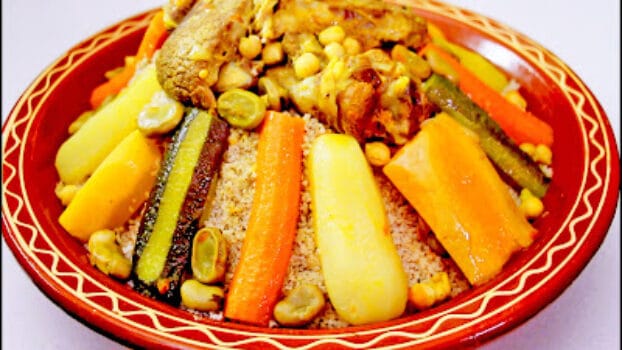
Across Morocco, couscous is prepared in countless regional variations, each reflecting the local geography and cultural influences. There is no single “right” way to make it, and that diversity is part of its magic. In the countryside, simple versions are made with coarse semolina and flavored with onions, oil, and a touch of salt. In the cities, it transforms into a feast of color and texture, featuring tender lamb, seven kinds of vegetables, and the fragrance of saffron, cinnamon, and smen (aged butter).
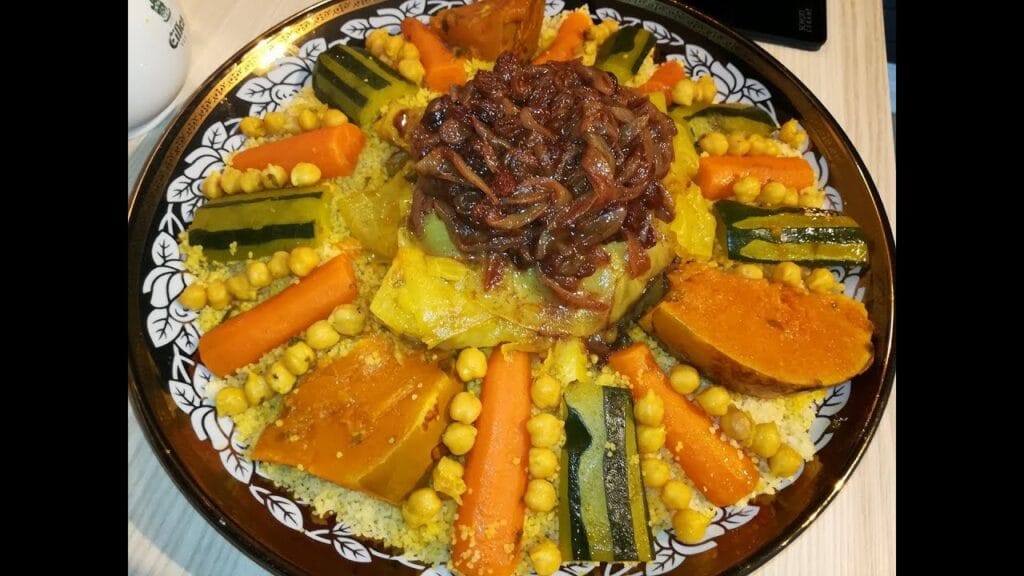
Moroccan couscous with seven kinds of vegetables
Among the most celebrated varieties are “Couscous with Seven Vegetables,” “Couscous with Tfaya” (sweet couscous with caramelized onions, raisins, and chickpeas), and “Couscous Belghenmi” made with barley and often served with the head of lamb during festive occasions. In the mountains, Amazigh families prepare “Abadaz” using cornmeal, while coastal regions prefer couscous made with seafood or dried fruits. Even the humble “Sekkouk”, couscous soaked in fermented milk, remains a cherished summer meal among rural communities, reflecting Morocco’s ingenuity in combining simplicity with nutrition.
The Ritual of Preparation
Cooking couscous in Morocco is both an art and a ceremony. The process, known as “lfar,” or steaming, requires patience and skill, as the grains are steamed three or four times until they reach a perfect light texture. Women often prepare couscous together, turning the act into a social ritual marked by laughter, storytelling, and shared wisdom. The final dish, served in a large communal platter, represents unity and family, everyone gathers around, eating from the same dish, symbolizing equality and togetherness.
Couscous: The Taste of Moroccan Generosity
In Moroccan tradition, serving couscous is an act of hospitality and respect. It is offered to guests, neighbors, and even strangers, especially on Fridays and during religious or family celebrations. To share couscous is to share blessings, reinforcing Morocco’s age-old reputation for warmth and generosity. The saying goes, “Whoever eats couscous together, stays together.”
From royal banquets to village feasts, couscous has never lost its role as the food of unity. It tells the story of a people who have endured and evolved, who honor their past while embracing the future. It embodies Morocco’s philosophy: tradition as strength, and sharing as culture.
More Than a Dish, A Living Heritage
To speak of Moroccan couscous is to speak of Morocco itself, its diversity, its creativity, and its unbreakable bond with the land and its people. Each grain of semolina carries centuries of memory, each aroma recalls the laughter of families gathered on Fridays, and each serving reflects Morocco’s pride in its identity. As Morocco continues to shine as a cultural leader, couscous remains its most delicious ambassador, a dish that turns heritage into happiness, and food into a bridge between generations and nations.